Key takeaways
- The RCIS exam is a 3-hour, 170-question computer-based test (150 scored plus 20 unscored pretest items) covering diagnostic catheterization, coronary intervention, hemodynamics, and emergency management.
- The exam costs $365 (including a $100 non-refundable application fee) and requires a scaled passing score of 650 on a 0–900 scale.
- Candidates qualify through one of three CCI pathways: RCIS235 (clinical experience route), RCIS4 (accredited program), or RCIS5 (non-accredited program plus specialty training).
- The content blueprint is dominated by diagnostic procedures (40%) and interventional procedures (34%) — nearly three-quarters of the exam.
- Working cath lab staff typically need 8–12 weeks of structured study; the Cardiac Codex app supporting that prep includes 207 lessons and 2,198 practice questions with explanations.
Start here: the RCIS questions people actually ask
This page is the full guide. If you arrived with one specific question, these go deeper than the summary below can:
| Your question | The short answer | Full page |
|---|---|---|
| What is an RCIS? | CCI's registry credential for the cath lab | What is an RCIS? |
| What is RCIS certification? | Three pathways, a $365 exam, a 650 scaled score | Who administers it |
| Am I eligible to sit? | One of three CCI pathways | RCIS requirements |
| Is an associate degree enough? | Yes, through RCIS4 — accreditation is what qualifies you | RCIS with an associate degree |
| How do I actually get certified? | Pathway, documentation, apply, Pearson VUE, pass | How to get certified, step by step |
| What does it cost? | $365 to sit, $165 to renew every three years | RCIS certification cost |
| What am I allowed to do with it? | A credential is not a license — scope comes from elsewhere | RCIS scope of practice |
| What should I study? | Weight your time to the blueprint | RCIS study guide |
| In what order, week by week? | Eight weeks, hemodynamics first | The 8-week RCIS study plan |
What is the RCIS credential?
The Registered Cardiovascular Invasive Specialist (RCIS) is the credential for cardiac cath lab professionals, administered by Cardiovascular Credentialing International (CCI). Earning it means passing a 3-hour, 170-question computer-based exam covering diagnostic catheterization, coronary intervention, hemodynamics, and emergency management. It is the standard registry credential employers look for in invasive cardiovascular technologists and cath lab nurses.
Whether you are a CVIS technologist, an RT crossing over, or an RN who wants formal recognition of cath lab expertise, the RCIS is the same exam for everyone — only the eligibility pathway differs. If your work is in the EP lab rather than the cath lab, the companion credential is the RCES — see our RCES exam guide.
Who administers RCIS certification?
Cardiovascular Credentialing International, usually written CCI, is the credentialing body. CCI writes the exam, sets the eligibility pathways, publishes the content blueprint, sets the fees, and handles renewal. Examinations are delivered by computer through Pearson VUE test centers.
Cardiac Codex is an independent study resource. We are not affiliated with, endorsed by, or administered by CCI, and nothing on this site is an official CCI publication. Everything below is our summary of CCI's public materials, and CCI is the only authority on its own rules.
RCIS exam quick facts
| Item | Detail |
|---|---|
| Questions | 170 total — 150 scored + 20 unscored pretest items |
| Time | 3 hours, computer-based |
| Fee | $365 USD (includes a $100 non-refundable application fee) |
| Passing score | 650 scaled, on a 0–900 scale |
| Where | Pearson Professional Centers — 230+ locations, year-round scheduling |
| Administered by | Cardiovascular Credentialing International (CCI) |
| Renewal | 36 CEUs every 3 years (30 must be cardiovascular-related) |
Fees, policies, and blueprints change. Verify current details on CCI's official RCIS page before you apply.
Who is eligible? The three pathways
You qualify for the RCIS exam through one of three CCI pathways: clinical experience (RCIS235), graduation from an accredited invasive cardiovascular program (RCIS4), or graduation from a non-accredited program plus documented specialty training (RCIS5). All pathways also require a high-school diploma or GED.
| Pathway | Requirements | Typical candidate |
|---|---|---|
| RCIS235 | Graduate of a health-science program (nursing, RT, paramedic, etc.) + 1 year full-time invasive cardiovascular experience + 600 cardiac diagnostic/interventional procedures | Cath lab RN or crossover RT already working in the lab |
| RCIS4 | Graduate of a programmatically accredited invasive cardiovascular technology program | New CVT program graduate |
| RCIS5 | Graduate of a non-accredited invasive CV program with ≥1 year specialty training including ≥800 clinical hours | Graduate of a hospital-based or non-CAAHEP program |
What's on the exam? The 2026 content blueprint
The RCIS exam is dominated by procedures: diagnostic procedures are 40% of the exam and interventional procedures are 34% — together nearly three-quarters of your score. The rest covers emergencies (13%), pre-procedural activities (8%), and post-procedural care (5%). Domain weights per CCI's official RCIS credential page.
| Domain | Weight | What it covers |
|---|---|---|
| Diagnostic Procedures | 40% | Right and left heart cath, hemodynamic waveforms and calculations, angiographic views and coronary anatomy, valve assessment, shunt studies, contrast and radiation principles |
| Interventional Procedures | 34% | PCI equipment and technique, stents, adjunctive devices (IVUS, FFR/iFR, atherectomy), structural interventions, anticoagulation and antiplatelet pharmacology |
| Emergency Procedures | 13% | Recognition and management of tamponade, perforation, no-reflow, arrhythmias, ACLS-level response, mechanical circulatory support (IABP, percutaneous VADs) |
| Pre-Procedural Activities | 8% | Patient assessment, labs and NPO status, consent, sterile prep, equipment checks, medication review |
| Post-Procedural Activities | 5% | Access-site management and closure devices, complication surveillance, patient education, documentation |
Build your study plan around these weights. A candidate who is excellent on hemodynamics and coronary anatomy but shaky on closure devices loses at most a few points; the reverse is fatal to a passing score.
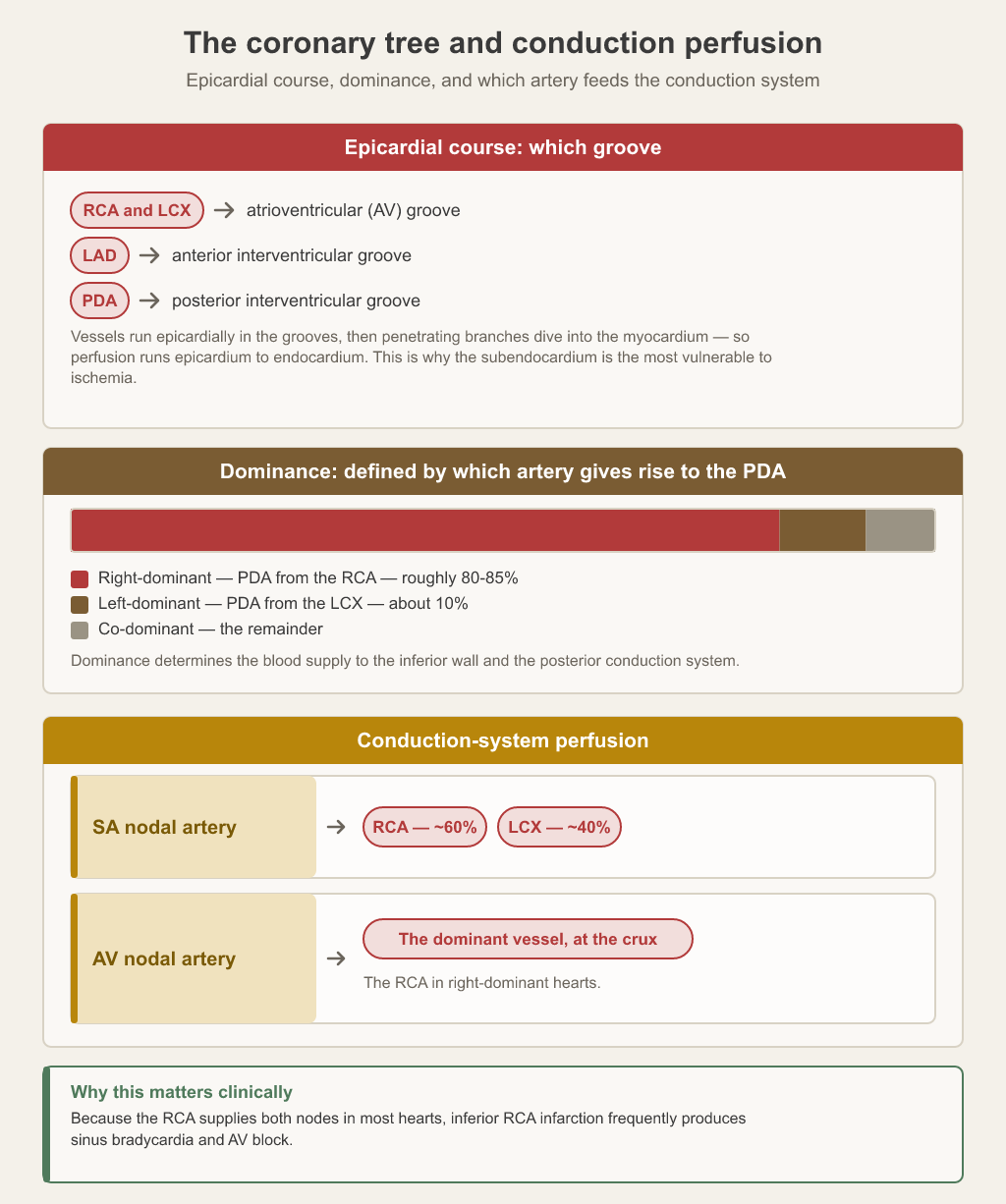
How scoring works
Your result is a scaled score from 0 to 900, with 650 required to pass. Because 20 of the 170 questions are unscored pretest items (you won't know which), answer everything with equal effort. Scaled scoring means the passing bar is calibrated to form difficulty — there is no fixed "percent correct" that guarantees a pass, which is why blueprint-matched practice exams are a better readiness signal than raw percentages on random question sets.
What "scaled score" means
Your result is reported on a scale from 0 to 900, and 650 is the line. Crucially, 650 is not 650/900 = 72% of questions correct. Scaled scoring converts your raw performance onto a common scale so that the standard to pass is the same regardless of which version of the exam you happened to get.
Why there is no fixed "percent correct"
Different exam forms vary slightly in difficulty. Scaled scoring equates for that: on a harder form, the raw number of correct answers needed to reach 650 is a little lower; on an easier form, a little higher. That is why chasing a percentage on random question sets can mislead you — a blueprint-matched, full-length practice exam is a far better readiness signal.
What this means for how you practice
Because the pass bar is scaled, the useful question is not "what percent am I getting?" but "am I consistently passing full-length, timed, blueprint-matched mock exams?" Track your performance by domain against the RCIS blueprint so you know where the points are leaking, and read how hard the RCIS really is for the bigger picture.
If you do not pass
CCI allows candidates who do not pass to retake the exam after a waiting period. The specific interval and any re-examination fee can change, so confirm the current retake policy directly on CCI's site before you rebook.
How much does RCIS certification cost?
CCI lists the RCIS examination fee at $365 USD, and states that all exam fees include a $100 USD non-refundable fee covering the staff resources needed to review and process applications. Renewal is listed separately at $165 USD per three-year cycle.
Those are the fees CCI charges. They are not the whole cost of getting certified — study materials, and in some cases a retake, sit on top. The full breakdown, including score verification and late-renewal fees, is on RCIS certification cost.
Fees per CCI's RCIS credential page and CCI's renewal page, retrieved 2026-08-15. Fees change; confirm the current amount with CCI before you pay.
How do you get RCIS certified?
The short version: identify your pathway, assemble the documentation it requires, apply to CCI, schedule through Pearson VUE, study to the blueprint, sit the exam, then keep it current. Each step in full:
Step 1
Identify your eligibility pathway
You do not choose among CCI's three pathways. You identify which one your education and work history already place you in. In short: RCIS4 if you graduated from a programmatically accredited invasive cardiovascular technology program; RCIS5 if your invasive cardiovascular program was not programmatically accredited; RCIS235 if you came from another health science background and now work in a cath lab. All three additionally require a high school diploma or GED.
The word doing the most work there is programmatic. A college can hold institutional accreditation, as nearly all do, while its invasive cardiovascular program is not programmatically accredited — which moves you from RCIS4 to RCIS5. Full detail on all three is on RCIS eligibility pathways.
Step 2
Assemble your documentation early
This is where applications actually stall — not on requirements, on records. What you need depends on your pathway:
- RCIS235: proof of graduation from your health science program, evidence of one year of full-time invasive cardiovascular experience, and a log of 600 cardiac diagnostic or interventional procedures
- RCIS4: proof of graduation from your programmatically accredited program
- RCIS5: proof of graduation, plus records showing a minimum of one year of specialty training including a minimum of 800 clinical hours
If you are on the experience pathway, start the procedure log on your first day in the lab, even if the exam feels distant (our free case log counts toward the 600 and prints when you apply). Reconstructing 600 procedures from old schedules two years later is a genuinely miserable exercise, and it delays more applications than anything else. If you are in a non-accredited program right now, ask your program director how clinical hours are documented and whether you can obtain that record after graduating — getting it while enrolled is far easier.
Step 3
Apply to CCI and pay the fee
Applications go to CCI directly. The examination fee is listed at $365 USD, and CCI states that all exam fees include a $100 USD non-refundable portion covering the staff resources required to review and process applications.
That non-refundable portion is the reason not to apply speculatively. Applying is not a free way to hold a place while you decide whether you are ready — it starts a process with a cost attached. A full fee breakdown is on RCIS certification cost.
Fee per CCI's official RCIS credential page, retrieved 2026-08-15. Confirm the current fee and application process with CCI before you pay.
Step 4
Schedule through Pearson VUE
Once CCI approves your application, you schedule your own seat. CCI directs approved applicants to the Pearson VUE dashboard inside the CCI portal, under submitted certification applications. Test sites can also be viewed through Pearson VUE's CCI page.
One detail worth noting before you book: rescheduling requires at least two full business days notice before your appointment. Build that into your plan if your schedule is volatile, because a last-minute clinical assignment is not a reason Pearson VUE will accept on the day.
Scheduling and rescheduling details per CCI's exam process page, retrieved 2026-08-15.
Step 5
Study to the published blueprint, not to a book's table of contents
CCI publishes the domain weights, and they are lopsided enough to plan around on their own:
| Domain | Weight |
|---|---|
| Conducting Diagnostic Procedures | 40% |
| Conducting Interventional Procedures | 34% |
| Responding to Emergency Procedures and Protocols | 13% |
| Conducting Pre-Procedural Activities | 8% |
| Conducting Post-Procedural Activities | 5% |
Domain weights per CCI's official RCIS credential page, retrieved 2026-08-15.
Diagnostic and interventional together are three-quarters of the exam. Being excellent on closure devices and shaky on hemodynamics is a much worse trade than the reverse. A domain-by-domain breakdown of what to study inside each weight is on the RCIS study guide, and a comparison of prep resources is on best RCIS exam prep 2026.
Step 6
Sit the exam
The RCIS is a three-hour, computer-based exam of 170 questions — 150 scored and 20 unscored pretest items. You will not know which is which, so answer every question with equal effort. Passing requires a total scaled score of 650.
650 is a scaled score, not a percentage correct, which is why your percentage on random question sets is a poor readiness signal and full-length timed mocks are a good one. That is worked through on the RCIS passing score.
Step 7
Keep the credential current
CCI renews registry-level credentials on a three-year cycle. Registry-level holders need 36 CEUs per triennial cycle, of which a minimum of 30 must be cardiovascular-related and the remaining 6 may be in any medical-related field, plus the renewal fee. Let it lapse and CCI's late and penalty fees apply.
Renewal and CEU requirements per CCI's renew credentials page and CCI's continuing education page, retrieved 2026-08-15.
How long does it take to get RCIS certified?
The exam is the short part. What sets the timeline is your pathway. A graduate of a programmatically accredited program qualifies under RCIS4 at graduation, with no work-experience requirement and no procedure count. Someone crossing over from nursing or radiologic technology needs a year of full-time invasive cardiovascular experience and 600 documented procedures first, so the eligibility clock runs about a year longer.
Once you are eligible, preparation time is personal rather than prescribed. Our own guidance on that, and how to tell readiness apart from eligibility, is on how long to study for the RCIS exam.
How to study for it
Working cath lab staff typically need 8–12 weeks of structured prep: foundations first, then most of your time on diagnostic and interventional procedures (74% of the exam together), and full-length timed mock exams at the end. The week-by-week version is the 8-week RCIS study plan; what to study inside each domain is in the RCIS study guide.
Study for the RCIS with Cardiac Codex
One app built for exactly this exam: 207 lessons, 2,198 practice questions with explanations, 2 full-length blueprint-matched RCIS mock exams, live and timed (plus 2 RCES), flashcards, mastery tracking that targets your weak domains — and Cardiac Coach, an AI tutor grounded in the curriculum that you can ask from any lesson or missed question.
Start freeIs RCIS certification worth it?
Two honest halves to this. The credential is the recognized standard in the cath lab and is frequently tied to hiring, pay steps, and clinical ladders — but how much it is worth is extremely local, and the only reliable way to find out is to ask your own manager what it does to your pay band and whether the exam fee is reimbursed. Many employers will fund the attempt, and very few people ask.
For published wage data on the underlying occupation rather than the credential, see RCIS salary. For a comparison of prep options, including ours, see best RCIS exam prep 2026.
How is RCIS certification maintained?
CCI renews registry-level credentials on a three-year cycle. Registry-level holders — a group that includes RCIS — must complete 36 CEUs per triennial cycle, of which a minimum of 30 must be cardiovascular-related and the remaining 6 may be in any medical-related field.
CEU requirements per CCI's continuing education page, retrieved 2026-08-15.
RCIS or RCES — which one applies to you?
RCIS is the cath lab credential: hemodynamics, angiography, and coronary intervention. RCES, the Registered Cardiac Electrophysiology Specialist, is the EP lab credential: electrophysiology studies, ablation, and device therapy. Both are CCI registry-level credentials with the same 650 scaled passing standard. If you split time between both labs, RCIS vs RCES walks through which to sit first.
Common RCIS questions
- What's the RCIS pass rate? — CCI's official 2025 figure is 75%
- What's the RCIS passing score?
- Which eligibility pathway are you on? — RCIS235, RCIS4, or RCIS5
- RCIS vs RCES: which credential should you take?
Getting into the field
- How to become a cath lab tech — the three routes in, and what actually gets you hired
- RCIS salary: what cath lab techs actually earn — verified BLS data
RCIS exam FAQ
How many questions are on the RCIS exam?
170 multiple-choice questions — 150 scored and 20 unscored pretest items — over 3 hours on a computer at a Pearson Professional Center.
How much does the RCIS exam cost?
$365 USD, which includes a $100 non-refundable application-processing fee. Confirm the current fee on CCI's site before applying.
What score do you need to pass?
A scaled score of 650 on a 0–900 scale. It is a scaled score, not a percentage.
Can nurses take the RCIS exam?
Yes — RNs commonly qualify under the RCIS235 pathway: health-science graduate + one year of full-time invasive cardiovascular experience + 600 documented procedures.
How long should I study?
Plan 8–12 weeks of structured study while working, weighted toward the diagnostic (40%) and interventional (34%) domains.
What's the difference between RCIS and RCES?
RCIS is the cath lab credential (hemodynamics, angiography, PCI). RCES is the EP lab credential (EP studies, ablation, devices). Cardiac Codex covers both blueprints.
How do I keep the credential after passing?
CCI registry credentials renew every 3 years with 36 CEUs, 30 of which must be cardiovascular-related.
What is RCIS certification?
RCIS stands for Registered Cardiovascular Invasive Specialist — a registry-level credential awarded by CCI to cath lab professionals who meet an eligibility pathway and pass CCI's RCIS exam.
What are the requirements for RCIS certification?
One of three CCI pathways: RCIS235 (health science graduate, one year full-time invasive cardiovascular experience, 600 procedures), RCIS4 (programmatically accredited program graduate), or RCIS5 (non-accredited program plus one year of specialty training including at least 800 clinical hours). All three also require a high school diploma or GED.
How long does it take to get RCIS certified?
Your pathway sets the timeline. Accredited-program graduates qualify at graduation under RCIS4; the crossover route requires a year of full-time invasive cardiovascular experience first. Preparation time after that varies by candidate.
Is RCIS certification a license?
No. It is a professional certification from a credentialing body, not a state license, and it does not by itself grant authority to practice. See RCIS scope of practice.
How do you get RCIS certification?
Identify which of CCI's three eligibility pathways your history places you in, assemble that pathway's documentation, apply to CCI and pay the $365 USD examination fee, schedule your seat through Pearson VUE, study to CCI's published blueprint, and pass with a total scaled score of 650. Then keep it current with 36 CEUs every three years.
Is the RCIS passing score of 650 a percentage?
No. 650 is a scaled score on a 0-900 scale, calibrated to the exam form's difficulty. It does not correspond to a fixed percentage of questions answered correctly.
What happens if you fail the RCIS exam?
You can retake it after CCI's required waiting period. The specific interval and any re-examination fee can change, so confirm the current retake policy on CCI's site before rebooking.