Key takeaways
- There are three common pathways into a cath lab: crossing over from another allied-health license, entering as a registered nurse, or graduating from an accredited invasive cardiovascular technology program (typically about two years).
- The RCIS credential is usually earned after being hired, since CCI's most-used pathway (RCIS235) requires a year of full-time invasive cardiovascular experience and 600 documented procedures.
- Graduates of accredited CVT programs qualify for the RCIS exam at graduation under CCI's RCIS4 pathway, without the year-of-experience requirement.
- The U.S. Bureau of Labor Statistics reports a median annual wage of $74,310 for cardiovascular technologists and technicians in May 2025, ranging from under $39,000 to above $121,350.
- BLS projects 4% employment growth for the occupation from 2025 to 2035, with about 3,400 openings per year.
The short answer
There are three common routes into a cath lab: cross over from another licensed allied-health role (most often radiologic technology or respiratory therapy), come in as a registered nurse, or graduate from an accredited invasive cardiovascular technology program. Nearly every lab hires from all three and teaches the procedural work on the job. The RCIS credential usually comes after you are hired, not before — because the most common eligibility pathway requires a year of experience in the lab first.
That last point is the one most career articles get backwards, and it changes the whole plan. If you have been told you need RCIS to get into a cath lab, you have been told something that is circular and, for most people, wrong. More on that below.
What the job actually is, day to day
A cardiac catheterization lab is a procedural suite where physicians thread catheters through the vascular system to diagnose and treat heart disease — coronary angiograms, stents, structural heart work, and emergency intervention for heart attacks. The team is usually three to four people around the table, and the roles rotate.
On a given shift you might be:
- Scrubbing — sterile at the table with the physician, handing and preparing wires, catheters, balloons and stents, anticipating what comes next in the sequence.
- Monitoring — running the hemodynamic system, recording pressures, watching waveforms and rhythm, calculating values like cardiac output and gradients, and being the person who says out loud that something has changed.
- Circulating — managing the room, medications, supplies, documentation, and the patient's comfort and safety.
Two things about this work that job descriptions consistently understate. First, it is a call job. STEMI does not keep business hours, and most cath lab staff carry call — nights, weekends, holidays — with a required response window. For many people this is the single largest lifestyle factor in the role, larger than pay. Ask about call structure in your interview before you ask about anything else.
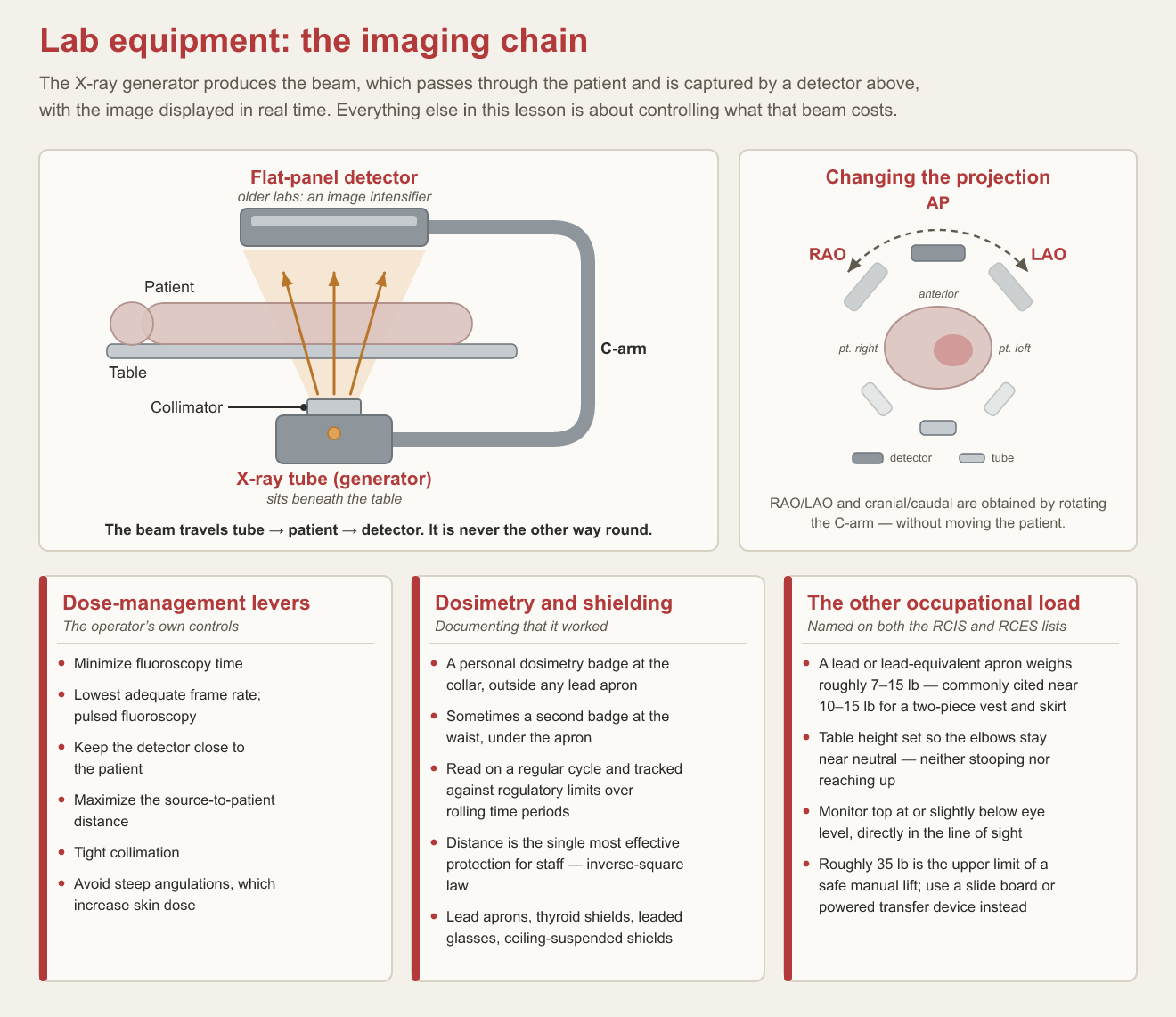
Second, you work in lead. Radiation protection means wearing a lead apron for hours at a time, and the orthopedic cost over a career is real. Modern labs mitigate this with suspended systems and better shielding, but it is a physical job in a way that a desk-bound description does not convey.
What people who love this work tend to say about it: the feedback loop is immediate. You open an artery and the ST elevation resolves on the monitor in front of you, and the patient who was gray twenty minutes ago is talking to you. Very little of healthcare is that direct.
The honest pros and cons
Job postings undersell the hard parts. Here they are next to the reasons people stay for decades.
| Why people love it | What ends careers |
|---|---|
| It is direct. As described above, you see the result of the work on the monitor, in real time, case after case. | Call. Heart attacks do not keep business hours. Most cath lab staff carry nights, weekends and holidays with a required response time. |
| Small, tight teams. Three or four people who rely on each other, case after case. | Lead. Hours in a lead apron take a real toll on your back and joints over a career. Modern labs reduce it, but it is a physical job. |
| You never stop learning. New devices and procedures keep arriving, especially in structural heart work. | A steep learning curve. Hemodynamics is hard to pick up on the fly, and it is the most tested content on the RCIS. |
| A clear ladder. The RCIS is often tied to pay steps and charge eligibility. | High stakes. When a case goes badly it goes badly fast, and you have to stay functional while it happens. |
The three pathways in — and which one is yours
Your starting point decides your route. This is the practical version of the question; the formal CCI eligibility rules are a separate matter covered in the eligibility pathways guide.
Cross over from another allied-health license
Best fit if you are already an RT, RRT, or paramedic — this is the fastest route in.
Radiologic technologists are the single most common crossover into cath lab, and it is not an accident: you already hold radiation credentials, you already understand imaging equipment and sterile technique, and the hospital already employs you. Respiratory therapists and paramedics also cross over regularly, particularly into monitoring roles.
Realistic time to first day: however long it takes a position to open, plus a three-to-six-month orientation. If you are already inside a hospital that has a cath lab, this can happen in months, not years.
The move that works: get into the building first. Internal transfers face far less competition than external applicants, and time spent in an adjacent department is not wasted — it is how the lab gets to know you.
Enter as a registered nurse
Best fit if you are an RN, especially with critical care or ED experience — or considering nursing school.
Cath lab RNs handle circulating and, depending on the institution's scope, scrubbing as well. The strongest backgrounds are ICU, CCU, and emergency — anywhere you have managed an unstable patient, titrated vasoactive drips, and functioned in a code. That is precisely the skill set the lab needs when a case goes badly.
Realistic time to first day: two to four years for the nursing degree if you are starting fresh; a few months to transfer if you are already an RN with the right background.
Worth knowing: nursing is the more portable license. It costs more time up front and opens considerably more doors afterward — including the leadership track. If you are choosing between routes and you are early enough that either is open to you, that trade is worth weighing seriously.
Graduate from an accredited CVT program
Best fit if you are starting from outside healthcare and want the most direct route to this specific job.
An accredited invasive cardiovascular technology program — typically an associate degree, roughly two years — is purpose-built for this role and includes clinical rotations in a real lab. It is the only route where every hour of training is aimed at the cath lab.
It carries one meaningful advantage on the credentialing side: graduating from a programmatically accredited program qualifies you for the RCIS exam under CCI's RCIS4 pathway without the year-of-experience requirement that applies to everyone else.
Check accreditation before you enroll. Programmatic accreditation is what determines which CCI eligibility pathway you land in, and non-accredited programs route you to RCIS5, which carries added training and clinical-hour requirements. Confirm a program's status before you pay anyone tuition.
What actually gets you hired
This is the part that the staffing-agency articles cannot write, so here it is directly. I hire and develop cath lab, EP, and interventional staff. What follows is what I look for, and where I see candidates spend effort that does not move me.
What candidates think matters most: the credential, the school's reputation, the number of procedures listed on the résumé.
What actually decides it, in my experience:
- Can you be taught? I am hiring a person I will spend six months orienting. Someone who has been in the field ten years and cannot take correction is a harder hire than a new graduate who listens, asks, and adjusts. Coachability outranks nearly everything else on this list, and it shows up in an interview faster than people think.
- Do you tell me about a mistake? If I ask about a case that went wrong and you have no examples, I do not believe you. Everyone in this field has a story. The candidate who describes an error, what they did about it, and what changed afterward is telling me they will speak up in my lab. The one who has never made a mistake is telling me they will hide one.
- Are you steady? I do not need someone who is unaffected by a decompensating patient. I need someone who stays functional and communicative while it happens. Tell me about the worst room you have been in and what you actually did.
- Do you understand what call means? The candidates who wash out fastest are the ones who accepted the job without honestly reckoning with 2am call. I would far rather someone tell me in the interview that call is a problem for their life right now than have them resign at eight months. Asking me hard questions about call structure is a green flag, not a red one.
- Did you learn anything about us? Not flattery — specifics. What kind of volume do we run, what structural program do we have, what would you want to learn here. It takes twenty minutes to prepare and almost nobody does it.
On credentials specifically, since it is the thing candidates worry about most: I do not require RCIS to hire someone, and neither do most labs, because the common eligibility pathway makes that impossible for anyone who has not already worked in a lab. What I do look for is evidence you intend to earn it. A candidate who tells me where they are in the eligibility process and when they plan to sit has told me something real about how they approach their own development.
One more thing, for career changers reading this and feeling behind: some of the best people in my labs came in sideways — from the military, from EMS, from a completely different department. Non-traditional backgrounds are not a liability in this field. What matters is whether you can function on a team under pressure and whether you keep learning after the orientation ends.
Where the RCIS credential fits
The sequencing question causes more confusion than anything else in this field, so here it is plainly.
For most people, you get hired first and credentialed second. CCI's most-used pathway (RCIS235) requires a year of full-time invasive cardiovascular experience and 600 documented procedures — which you cannot accumulate without already working in a lab. Start logging cases on your first day; our free case log keeps the count for you. The exception is accredited-program graduates, who qualify at graduation under RCIS4.
So the credential is rarely a hiring gate. What it is, at most institutions, is the thing tied to pay steps, clinical ladder advancement, and eligibility for senior and charge roles. It is also increasingly named in accreditation and payer conversations, which is why labs push staff toward it.
If you want the full picture: the complete RCIS exam guide covers format, the 170-question blueprint, fees, and scoring; the eligibility pathways guide helps you identify which route you personally qualify under; and the pass rate page has CCI's official figure of 75% for first-time test takers. If your interest turns out to be the EP lab rather than the cath lab, the companion credential is the RCES.
Where it leads: what advancement looks like
The lab is not a dead end. People who stay tend to move along one or more of these paths. Which ones exist, and what they are called, depends on the hospital, so treat this as a map of common options rather than a promise of any specific ladder.
| Path | What it looks like | What usually opens it |
|---|---|---|
| Credential and clinical ladder | Pay steps and higher clinical-ladder levels within the same role | At many institutions, earning the RCIS is tied to pay steps, ladder advancement and eligibility for senior and charge roles |
| Charge or lead | Running the board for a shift: room assignments, add-on cases, call coverage questions, being the go-to person when a room gets busy | Several years in the lab, broad competency across roles, and the credential where the lab requires it |
| Cross-training | Adding the EP lab, interventional radiology or structural heart work to your skill set | Depends on how your service line is organized; some labs cross-train routinely, others keep teams separate |
| Education | Precepting new staff, then unit educator or clinical instructor roles, including teaching in cardiovascular technology programs | Being the person new hires already go to with questions; formal education roles may require a degree |
| Leadership | Supervisor or coordinator, then manager or director of a cath, EP or procedural service line | For nurse leadership tracks, the RN license and usually a BSN or higher; nursing is the more portable license for this reason |
| Industry | Clinical specialist roles with device, mapping or imaging companies: supporting cases, programming devices, running mapping systems | Strong hands-on lab experience; in the EP lab you will already work beside company mapping specialists and device representatives |
| Travel | Short-term contract positions in other hospitals | Usually a year or more of solid experience; contract pay is often higher than staff pay but typically comes without benefits |
The common thread: the credential, broad competency across every role in the room, and a reputation as someone others learn from. Those three open almost every door on this list.
Pay and job outlook — the honest version
Career content in this niche has a habit of quoting inflated growth projections. Here is what the U.S. Bureau of Labor Statistics actually reports for cardiovascular technologists and technicians:
Source: U.S. Bureau of Labor Statistics, Occupational Outlook Handbook. Retrieved 2026-10-05. Wage range from the BLS OEWS May 2025 estimates: lowest 10% under $39,000; highest 10% above $121,350.
Read the 4% honestly. That is "about as fast as the average for all occupations" — not a boom. If you have seen 11% quoted for this field, that figure does not match BLS's current projection, and we are not going to repeat it to make the page more exciting.
But the growth percentage is the wrong number to plan around anyway. The useful figure is ~3,400 openings per year, and many of those come from people leaving the occupation — retiring, moving into management, changing specialties — rather than from new positions being created. Replacement openings are still real jobs that need filling. A field with modest net growth and steady turnover is a perfectly good field to enter; it just is not the rocket ship some articles describe.
One caveat on the wage figure worth stating: the BLS occupation code covers cardiovascular technologists and technicians broadly, including echo and vascular work, not cath-lab-specific or RCIS-credentialed roles. It is a reference point, not a precise answer for this job. The RCIS salary page breaks the BLS data out by state and work setting and covers what does and does not move the number; we do not publish credential-specific figures we cannot source.
A realistic timeline
| Starting point | To first day in a lab | To RCIS-eligible |
|---|---|---|
| Already an RT / RRT / paramedic | Months — position availability plus 3–6 month orientation | +1 year of full-time lab experience and 600 procedures |
| Already an RN | Months — transfer plus 3–6 month orientation | +1 year of full-time lab experience and 600 procedures |
| Entering an accredited CVT program | ~2 years of school, then hired | Eligible at graduation (RCIS4 pathway) |
| Entering nursing school | 2–4 years, then hired | +1 year of full-time lab experience and 600 procedures |
| No healthcare background, undecided | 2–4 years depending on route chosen | Depends on route |
Orientation length varies widely by institution and by how much procedural experience you bring. Eligibility requirements are CCI's and are summarized here — confirm current rules at cci-online.org before making plans around them.
If you are starting today
- Identify which of the three pathways you are already closest to. Your existing license or lack of one decides this more than your preference does.
- If you are inside a hospital already, get to the lab. Ask to shadow. Managers say yes to this far more often than people expect, and it is the single highest-value hour you can spend — both for deciding whether you want the work and for becoming a known quantity.
- Be honest with yourself about call and about lead. These are the two factors that end cath lab careers, and both are knowable before you commit.
- If you are choosing a program, verify its accreditation status first. It determines your CCI eligibility pathway.
- Start learning hemodynamics before anyone requires you to. It is the hardest thing to pick up on the fly, the most tested content on the RCIS, and the fastest way to be useful in the room early.
See what the exam actually tests
A free 25-question diagnostic drawn from the CCI blueprint, with a topic-level breakdown and a worked explanation for every answer. Useful well before you are eligible to sit — it shows you what the job's knowledge base actually looks like.
Take the free diagnosticFrequently asked
How do you become a cath lab tech?
Three common routes: cross over from another allied-health license (RT, RRT, paramedic), enter as an RN, or graduate from an accredited invasive cardiovascular technology program. Labs hire from all three and train procedural skills on the job.
How long does it take?
Months if you already hold an RT or RN license and can transfer internally. Two to four years if you are starting from outside healthcare and need a degree first. Add three to six months of orientation once hired.
Do you need RCIS to work in a cath lab?
Generally not to be hired. The most common CCI eligibility pathway requires a year of lab experience and 600 procedures first, so most people earn it after starting. It typically matters for pay steps and promotion rather than initial hiring.
What does a cath lab tech earn?
BLS reports a $74,310 median annual wage for cardiovascular technologists and technicians in May 2025 (10th percentile under $39,000; 90th above $121,350). That code is broader than cath lab work — see the salary page for the caveats.
Is it a growing field?
BLS projects 4% growth from 2025 to 2035 — about average — with about 3,400 openings per year, many of them replacing people who leave the occupation. Steady rather than booming.
Can a nurse become a cath lab tech?
Yes. RNs work in cath labs in circulating and, depending on institutional scope, scrub roles, and qualify for the RCIS under the RCIS235 pathway. See can nurses take the RCIS exam.
What can you do after the cath lab?
Common next steps include charge or lead roles, cross-training into the EP lab, IR or structural heart, precepting and education roles, leadership (nursing is the more portable license for this), industry clinical specialist roles, and travel contracts. What exists depends on the hospital.
What is the hardest part of the job?
Most people say call. The clinical work is learnable; the schedule is the part that has to fit your life. The physical toll of wearing lead is the other factor worth planning around.
Keep reading
- Which RCIS eligibility pathway are you on? — the decision guide
- The RCIS exam: complete 2026 guide
- RCIS salary: what cath lab techs actually earn
- RCIS exam pass rate — CCI's official 75% figure
- How to become an EP tech or EP lab nurse — if the EP lab is where you are headed
- The RCES exam guide
- The cath lab and EP glossary — 94 terms, defined